Blog by Louise Davies, Chief Executive of Scottish Fair Trade
I’ve spent the first week of COP30 in Belém – partly work, partly good timing, as I’d already planned a holiday in Brazil. It’s been a real privilege to witness the pace, scale and sheer intensity of the climate conference up close, and to see global climate thinkers, campaigners and communities come together and, in theory, working side by side.
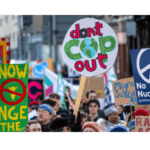
Belém is a powerful setting for this year’s COP: the first in four years to be held in a democratic country, and right at the mouth of the Amazon where the climate crisis is biting hard. Indigenous presence is strong everywhere, in the Blue Zone, outside on the streets, on campaign banners, and in countless side events. Forest protection and the financing needed to secure it are major themes, with a growing acknowledgement that Indigenous peoples’ leadership in conservation must be recognised and properly resourced. While the protests make headlines, what’s less reported is that Indigenous leaders are very much inside the COP halls too, pushing for their voices to land in the negotiations.
Just Transition is another headline issue. There’s a big civil society push for a new Belém Action Mechanism (BAM) for Just Transition, essentially a global framework to support locally led, socially just climate responses. Scottish campaigners are active on this, and given the Scottish Government’s long-standing commitment to Just Transition, it feels like another moment where Scotland could use soft power in a similar way to its early leadership on Loss & Damage. And speaking of Loss & Damage: Scotland is still claiming plenty of credit for its role in nudging the global community forward on this. The fund is now operational, and the Scottish Government is clearly keen to champion that progress and keep pressure on others to do more.
A standout moment last week was hearing Cabinet Secretary Gillian Martin speak alongside Vanuatu’s Climate Minister, who described the existential threat facing his island nation, and a climate academic from the Philippines who was receiving updates from her family at home as the 21st typhoon of the year made landfall. It’s hard to imagine anyone hearing these realities and not feeling the urgency. While the Cabinet Secretary highlighted that Scotland’s Climate Justice Fund and Loss & Damage contributions are “doing really, really well,” there’s no doubt we could go further – and that we also need to learn from countries like Vanuatu and the Philippines as we adapt at home. Scotland is far from immune to climate impacts.
Scottish Fair Trade is here with a clear message: climate justice and trade justice are inseparable. Fair and equitable trading relationships give producers the stability, income and long-term partnerships they need to adapt and become more resilient to climate shocks. Unfair trade structures, and the lack of meaningful market access, deepen vulnerability. Our new report showcases Fair Trade enterprises that are already innovating in climate action, but scaling this up requires integration in climate strategies, further investment and a larger market for Fair Trade. It’s been inspiring to hear from co-operatives and small scale farmers from around the world, echoing these calls.
We’re also calling for more corporate accountability at this ‘truth COP’. Voluntary measures simply aren’t delivering. It’s striking how many of the solutions being proposed across discussions on business and economy, supply chains, food and farming, workers rights and gender equity echo the 10 Fair Trade principles. If we’re serious about transforming business to put people and planet first, these principles are a ready-made starting point.
For all of the energy here, the process remains opaque, as many SCCS members who’ve been to COP before will know. The best window into the negotiations is through the constituency focal groups, where observers share updates you’d never otherwise pick up. The idea is that civil society then relays its views back to government delegations. In practice, it’s a mixed picture. I’ve seen more enthusiasm for high-profile ‘actions’ outside sessions (which, realistically, most negotiators will never see) than for the slow, technical work of drafting alternative proposals. But there are useful insights to be found.
From the latest meeting I attended: Just Transition discussions are moving, and there’s a proposal to include critical minerals for the first time, a potentially significant step, as it would introduce explicit human rights protections for workers in mineral extraction. There’s guarded optimism that a new Gender Action Plan can be agreed, though the usual countries are dragging their feet. And finance hangs over everything; it’s treated as a separate negotiating stream, yet it’s the thread running through all of them. Everyone agrees more money is needed and no one seems clear where it’s coming from.
Overall, it was a week that reflects the messy reality of COP: imperfect, imperfectly progressing, but full of people pushing hard for a fairer climate future. Scotland has a role to play in that, and we have plenty of good work to build upon.