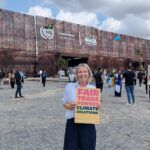
By Ben Wilson at COP30 in Belem, Brazil, director of public engagement for SCIAF and international policy lead for SCCS
This article was originally published in The Scotsman
Earlier this year, I travelled to Ethiopia to visit SCIAF projects in a region battered by drought and scarred by war. Both, in different ways, had been intensified by climate change. The landscape in the south of Ethiopia was literally strewn with the skulls of dead cattle – grim markers of a drought that killed millions of animals and destroyed the livelihoods of families who have herded them for generations. In the north, I met families displaced by war, amongst the some 750,000 are still living in temporary camps across the region, due to a conflict many experts agree was precipitated, at least in part, by climate change.
Ethiopia is not an isolated example. SCIAF sees this story written across the world. In Malawi, ever-stronger cyclones tear apart homes and harvests. In Zambia, a deepening food crisis undermines development gains made over decades. And even as COP30 unfolds here in Brazil, the Philippines is being battered yet again by typhoons – storms that delegates from Manila warn are becoming deadlier and more unpredictable, as they plead for the COP to be more ambitious in its commitments. For the Philippines delegation, however, the odds are pitted against them – a report from Kick Big Polluters Out today confirmed that there are 1,600 fossil fuel lobbyists here at COP30 – 50 times the number of people from the government of the Philippines.
As always, the poorest communities are hit first and hardest. Not simply because of where they live, but because of the deep inequalities that shape our world. Even in Scotland, climate impacts fall unevenly, hitting those with the fewest resources to cope – while the wealthiest enjoy the largest carbon footprints.
Climate change is uniquely global. It is fitting, then, that COP30 meets in the Amazon. People in Scotland rely on this rainforest more than most of us realise – for the air we breathe, for the stability of our weather, for the “atmospheric services” it provides freely and without complaint. And yet we find ourselves at a low point in global cooperation, when many people look on climate summits not with hope, but with weary cynicism.
That cynicism is understandable. One of the major early announcements at this COP was the launch of the Tropical Forests Forever Facility – an ambitious plan to protect one of humanity’s most important natural assets. The UK government spent months helping to design it, only to turn up empty-handed at the moment it mattered, the latest consequence of a budget crisis of its own making. Earlier cuts to the UK aid budget have further undermined our ability to be seen as a genuine climate leader.
The United States, meanwhile, is not here at all. In some ways that is a relief; better an empty chair than a delegation intent on blocking progress. But global leadership cannot simply be left vacant. Only weeks before COP, the International Court of Justice delivered a landmark advisory opinion: meeting climate commitments is a legal duty for all governments. The ruling will have profound implications for climate litigation around the world. Yet many will ask – with reason – whether the ICJ’s words will carry weight in an era when more and more governments are shrugging their shoulders at international law.
Across the world we are witnessing a collective forgetting of the post-war consensus and the international legal framework that underpins it. The ongoing genocide in Gaza is a devastating example of global systems failing to protect civilians or constrain power.
Climate and peace are woven tightly together. Climate change fuels conflict. Conflict makes climate impacts worse. And the entire purpose of COP is, in its own way, about powerful countries accepting limits on themselves for the sake of smaller, more vulnerable nations. It is a quiet, practical expression of solidarity – and a recognition that our fates are interconnected.
So we must not allow despair to drag us down. We must stay committed to multilateralism and international law, however unfashionable those words may sound in some quarters. And this COP must send a clear signal that global cooperation can still function without the US at the table.
Two areas being negotiated here in Belém offer hope – not the abstract kind, but practical steps even climate sceptics can support.
First, COP30 can establish a new mechanism – the Belém Action Mechanism – to support just transitions worldwide. Workers everywhere need to know that the shift away from fossil fuels will not leave them behind. A coordinated global effort can show that this transition, while urgent, can also be fair. This can be a signal to concerned workers that the COP is not an enemy of their future prosperity, but their ally.
Second, adaptation. Floods, droughts, cyclones and extreme heat are already reshaping communities everywhere. This is not ideological; it is observable fact. By agreeing a strong Global Goal on Adaptation, this COP can show families from Glasgow to Lilongwe that we will help them prepare for a more volatile world.
If we can secure these two outcomes – alongside renewed commitment to the Paris temperature goals and meaningful progress on transitioning away from fossil fuels – we can show the world that, like the states and cities in the US who proclaim they are “still in”, the international community has not given up.
This moment is too important to be derailed by geopolitical dysfunction. Too important to surrender to despair. If we lose hope, we stop trying – and that is a luxury the planet and future generations cannot afford.